By Vince robinson
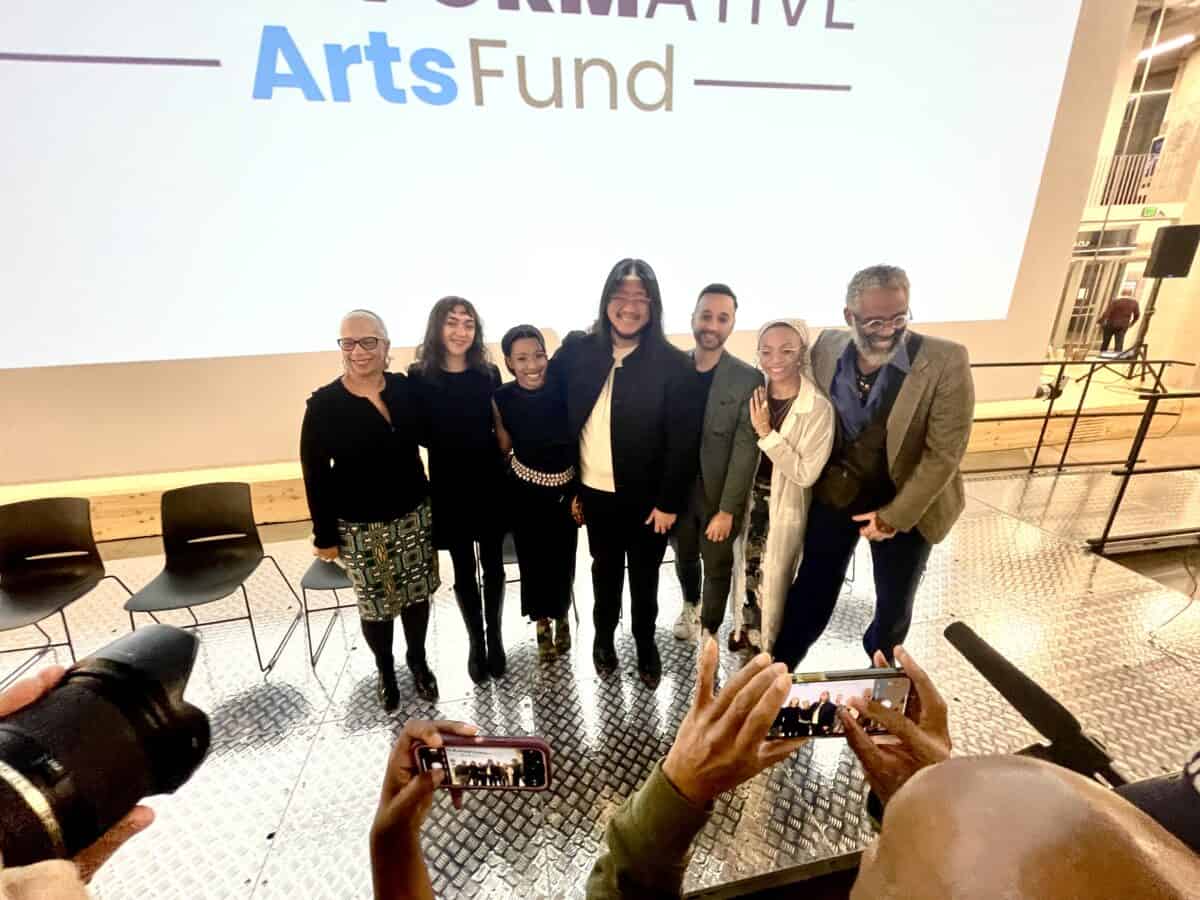
Cleveland’s Transformative Art Fund held a culminating event last week to share the success of seven curated projects executed in Cleveland thanks to $3 million in funding from the American Rescue Plan Act. Representatives of each of the seven teams had 12 minutes to tell their stories to a rapt audience in the Martin Luther King branch of the Cleveland Public Library on Wednesday, October 29th.
Rhonda K. Brown, Senior Chief Strategist for Arts, Culture and the Creative Economy for the City of Cleveland, was effusive in her praise of the projects she managed. They were chosen by her and a team of artist volunteers including the author of this editorial. The committee reviewed 103 proposals from artist-led teams and their institutional partners and whittled them down to the chosen seven.
According to Brown, “The Transformative Arts Fund embodies Cleveland’s unwavering belief in the power of art to activate the soul of the city and uplift its people. More than two years in planning and implementation, this initiative reflects a deep commitment to artist autonomy,”
The projects were diverse, ranging from 9413 Sophia Avenue: A Choreographed Deconstruction and Maintenance of the Built Environment led by artist Malena Grigoli, to All Our Babies: Birthing in the Afro Future, a groundbreaking initiative in Cleveland’s Fairfax neighborhood challenging high Black maternal and infant mortality rates led by dancer Jameelah Rahman.
History that led to the project.
Because of the pandemic, the Biden administration devised the American Rescue Plan Act. ARPA dollars were doled out to cities across the country. Cleveland received over $500 million. The Assembly for the Arts lobbied for $10 million and ended up with the approval of $3 million, a 2% appropriation.
The Assembly for the Arts, as stated in its mission declaration, is a 501(c)3 nonprofit organization with a focus on advocacy, cultural policy, racial equity initiatives, research, marketing that elevates the region, and services for nonprofits, artists, and creative businesses.
It served as the fiscal partner with the City of Cleveland to fund the projects because the city is not permitted to make direct payments for projects of this nature due to legal constraints.
Jeremy Johnson, President/CEO of the Assembly said “As fiscal agent, we built the back-end so the front-line could flourish, moving public dollars with care and speed, removing barriers, and ensuring artists and creative businesses were paid on time.TAF shows what Cleveland can do when we trust artists and invest close to home. It’s culture, yes, but it’s also connection, learning, small-business vitality, and neighborhood pride. Policy doesn’t change lives by itself; implementation does.”
The Assembly committed its staff to overseeing the process of payments to the artist teams that executed their projects, sacrificing the customary percentage of administrative fees of 9-15%, landing at 3%. In return, Cleveland received the gift of seven beautifully inspired projects fueled by the collective talent, knowledge and skills of an incredibly diverse array of artists, largely young, who brought them into fruition.
City leaders decided on the project-based approach, as opposed to simply passing out direct payments to individuals as had been done when County Executive Armond Budish approved $1.3 million in Coronavirus Aid, Relief and Economic Security (CARES) Act in which 425 artists received grants of $1,600.
Thanks to the Transformative Art Fund a larger number of artists received funding and in many instances, much greater amounts. In addition to merely receiving funds, they experienced personal and professional growth that went beyond receiving a government handout. This was an additional bonus to amplify the value the projects provided the city. It was the embodiment of the idea of transformation, not only of the communities that received the benefit of a project executed in their respective neighborhoods, but within the artists who executed the projects.
In an era in which the notion of diversity is being given a back seat to certain agendas, the TAF proved that its implementation provides positive results and a return on the investment in art and the intellectual capital the lies squarely in the minds of artists in our city.
The impact of the TAF will continue not only because public facing elements such as the murals and other artworks created exist, but because some of the projects have created programs that will extend the lives of their projects. This, again, reflects the transformative impact of what was created with the one-time gift from Uncle Sam. But the overarching reality is that this should not be the end of Cleveland’s journey with significant funding for the arts and the benefit that has been demonstrated with this single project.
It is time for Cleveland to consider perpetual support for the arts by including it in its budget. Cities like Philadelphia and Baltimore have done this and are seeing results. Other cities are doing the same. At present, a study is being conducted to examine exactly that with the idea that serious consideration can be made here.
It’s time for our political leaders to take action and empower artists to bring their voices into the rooms where decisions are being made about the future of this town. Creative input is a necessary element of problem solving. It can accompany legislation as a means of addressing those things that demand change.
The answer to our issues involving crime, poverty, illiteracy, environmental hazards, homelessness and the litany of other ills dominating the headspace of citizens in this city is not hiring more police officers. We can replace pistols with paint brushes, knives with musical instruments, fear with knowledge of self, and awareness of the power of art to combat the causes that underlie public safety concerns.
With this approach, we can truly transform this city and defy the current narrative that defines our place on the map as one of the worst cities in the country and see it for what it really is, a place where the arts thrive and natural resources exist in abundance. With the support of our political leadership, philanthropic partners, non-profit and for profit entities, we can be the solution and take this transformation to the next level.
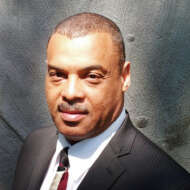
Vince Robinson is a member of the Transformative Art Fund selection committee and is a multi-genre artist residing in Cleveland, Ohio.